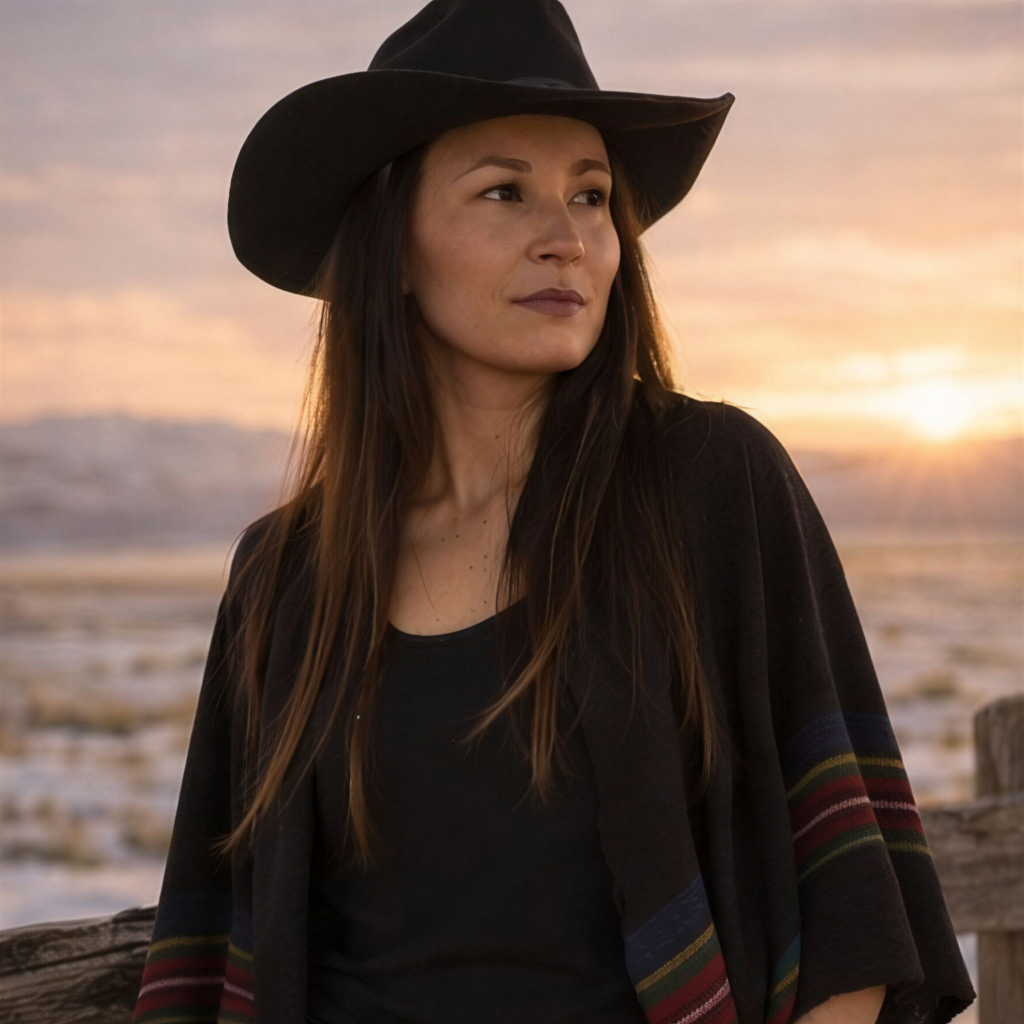

Long before stages, streaming numbers, or songwriting accolades, there were nights filled with stories. In a small rural town in Brazil, storytelling wasn’t treated as a performance. It was part of life. Families gathered close to woodstoves, mountain-style music drifted through rooms thick with memory, and voices carried histories that felt both fragile and permanent.
Those early moments would quietly shape the emotional language of an artist now known as The Red Betty, whose music exists somewhere between the ache of blues and the weathered poetry of mountain traditions.
Though she grew up in a larger city, the pull of the countryside remained constant. Time spent with family in rural settings left impressions that would later surface in her songwriting, not as nostalgia, but as instinct.
“My grandmother would pass down stories at night,” she reflects. “Simple music brought everyone together. Those evenings stayed with me. They taught me that songs are small pieces of life.”
That philosophy sits at the core of her artistry.
Rather than chasing genre labels or trends, The Red Betty has built her sound around emotional truth, what she half-jokingly describes as music that “smells green and has a bit of dusty shine to it.” It’s an evocative phrase, but also an accurate one. Her songs feel lived-in, grounded, and quietly cinematic, drawing from a lineage of artists who mastered the art of saying everything in just a few lines.

She cites mountain and Americana storytellers like Patsy Cline, The Carter Family, Emmylou Harris, and John Prine as formative influences. At the same time, blues voices such as Elizabeth Cotten, Joanna Connor, Big Mama Thornton, and Ella Fitzgerald left an equally profound imprint.
Somewhere in the intersection of those worlds, her voice began to take shape.
For The Red Betty, instrumentation is never an afterthought. Acoustic guitar, fiddle, and lap steel aren’t stylistic decorations. They are emotional tools. She learned to play the guitar by watching others, absorbing not only technique but the humanity embedded in imperfections.
“Instruments like these breathe,” she explains. “You hear fingers on the strings. You hear the wood. Those small imperfections remind you there’s a person behind the sound.”
That organic approach has become increasingly intentional in an era when production polish often overshadows emotional immediacy. By leaning into timeless textures, she creates songs that feel suspended between decades. Capable of belonging equally to a front porch fifty years ago or a late-night drive today.
If there is a thread running through her work, it is storytelling shaped by resilience. Themes of longing, reflection, heartbreak, and quiet perseverance surface repeatedly, not as dramatic declarations but as intimate observations.
Writing, she says, is often about processing life itself, conversations overheard, memories that refuse to fade, the subtle realization that growth rarely arrives without discomfort.
“There’s always that simple desire to keep going,” she notes. “To try to make tomorrow a little better than today.”
That emotional accessibility has helped her music resonate beyond geographic boundaries. Tracks like “Six Feet Under Love” connect with listeners navigating the complicated terrain between love and acceptance. The understanding that some relationships, no matter how meaningful, are not meant to endure.
“When a song speaks honestly about those feelings,” she says, “people recognize pieces of their own lives in it.”
The momentum behind her artistry became especially visible with “Icehouse“, a release that unexpectedly reached listeners across multiple regions and charted on both iTunes Country and Global rankings. For an independent artist accustomed to long stretches of quiet creative work, the response felt overwhelming.
“It was like a tidal wave of emotion,” she admits. “More than anything, it meant people were finding value in something I had written. Maybe even comfort.”
Support from fellow musicians and writers has further reinforced her belief in the power of narrative songwriting. Comparisons to literary voices such as Jesse Stuart — known for capturing rural life with poetic clarity — have been particularly humbling.
That connection between literature and music is no coincidence. The Red Betty approaches arrangement as a form of storytelling architecture. Decisions about when a fiddle enters or how much space a vocal occupies are treated with the same care a novelist might give to pacing or perspective.
“I think of the arrangement as something that cradles the listener,” she says. “It gently brings them into the world of the song.”
Live performances extend that philosophy into shared experience. Her shows are often described as intimate, almost conversational environments where audiences are invited to reflect, laugh, or sit quietly with their own memories.
If listeners leave feeling lighter or more understood, she considers the performance a success.
As anticipation builds around her upcoming album Bourbon Years & Holler Tears, The Red Betty continues to explore the emotional terrain that has defined her work. The record moves through heartbreak, desire, resilience, and the subtle ways people cope with life’s rougher seasons.
Early recognition has already begun. The song Juanita San Juan was named a 2025 Semi-Finalist in the International Songwriting Competition — a notable achievement for material drawn from an unreleased project.
Yet despite growing visibility, her perspective remains grounded. The music is not meant to romanticize hardship or endorse escapism. Instead, it acknowledges the human instinct to soften life’s edges while searching for meaning.
In a cultural moment often defined by speed and spectacle, The Red Betty offers something quieter but equally powerful — songs that move at the pace of reflection and linger long after the final note fades.

Her journey suggests that storytelling traditions, no matter how rooted in specific places or histories, can still travel widely when carried by authenticity.
And as she prepares to step further into the next chapter of her career, one thing remains clear: The Red Betty isn’t simply preserving mountain music. She’s allowing it to evolve — one honest story at a time.
Follow The Red Betty:
Spotify: https://open.spotify.com/artist/57IkaPPsnPz7bNVy7nC28S
YouTube: https://www.youtube.com/channel/UCEz41vigL8EOqilWuCCt0FQ
Instagram: https://www.instagram.com/redbettyband/?hl=en
